
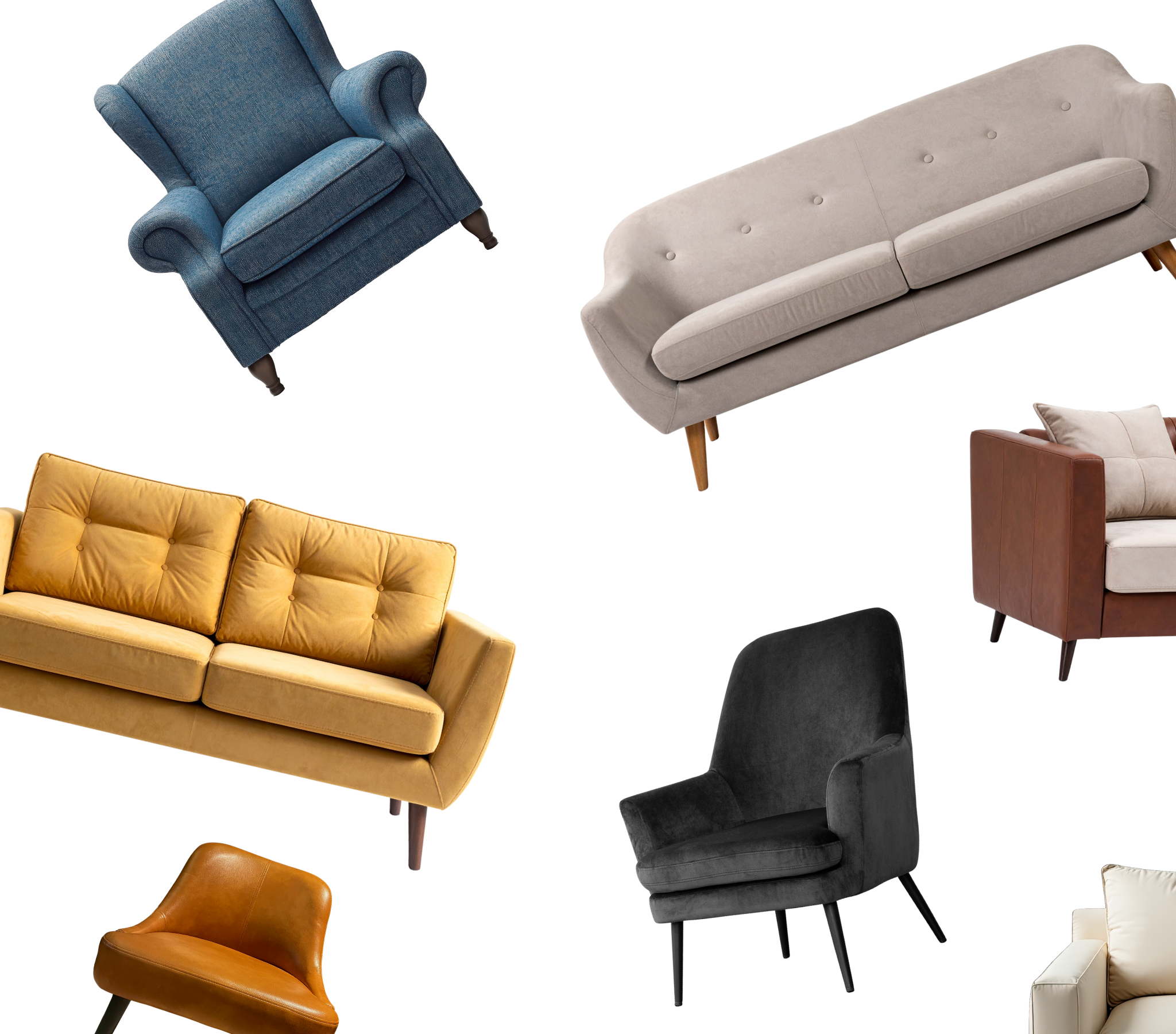
"How much fabric do I need?" is by far one of the most asked questions we get from everyday homeowners looking to upgrade or reupholster their furniture.
As people, it's so easy to forget that we can customize our homes however we want, and having an old, worn-down couch is the perfect opportunity to do so! You find yourself stepping into the world of textiles, where there are many, many colours and textures to choose from. Once you, as a homeowner, start looking for the right fabric, you will soon find yourself asking… "But how much fabric do I need?"
Here is a simple, detailed guide to help you out. This guide is available as a standard estimate and, if possible, it’s always better to consult your upholsterer first for a more accurate, straightforward amount. You are more than welcome to buy the fabric yourself and give it to them — no need to settle for something similar.
As a starting point, take a good look at your furniture. Is it average sized, or a little bigger or smaller than usual? For average sized furniture using plain (no pattern) fabric, use this estimate:
Small to Medium High-Back Chair: 6–7 meters each
Single Lounge Chair (part of a suite): 7–8 meters
Two-Seater Sofa: ±14 meters
Three-Seater Sofa: 16–18 meters
Four-Seater Sofa: 20–22 meters
This is based on average, standard sized furniture using fabric with a 1.4 meter width.
If you're thinking to yourself… But how do I know if my furniture is average sized or not? Don’t stress even for a moment! Grab your measuring tape and let me walk you through how to properly measure your couches and chairs.
Step 1: Measure Each Section Separately
Measure the inside backrest as well as the outside of the backrest. Measure the seat cushions and the back or scatter cushions. Then move to the bottom where you will measure the base or the seating platform. Lastly, if your couch or chair has armrests, measure both the inside and the outside of those too.
It’s best to round up to the highest number and measure in cm for better end results. Another useful make-or-break tip is to measure the highest and lowest points if your couch or chair has unique curves or rolled arms.
Step 2: Add Allowance for Seams and Upholstery Fitting
Upholstery is a very niche and very skilled sewing practice, which means your upholsterer will need a little extra space for seams and proper overall fitting. It is recommended to add an extra 5–10 cm.
Step 3: Consider Pattern Repeat
This step is specifically for those bold, pattern-loving people. When choosing a patterned fabric, you have to consider pattern repeat. Pattern repeat is basically about how the pattern falls and placing it in a certain way so that everything flows in the same direction. Your backrest, cushions, and armrests will likely be done one at a time and assembled at the end.
Choosing a pattern can significantly increase the fabric needed compared to plain fabrics, so keep that in mind.
If it is a deal breaker, you also have the option to choose a patterned fabric for the back and a matching plain colour for the front. We've seen people really enjoy this mix-and-match between the two fabrics, especially on armchairs. If that's not your style, I’ve got one more option for you, so you don’t have to say goodbye to the pattern that stole your heart. Luckily, most of our upholstery fabrics are very diverse, so you can always make a set of loose scatter cushions to add on top.
Step 4: Calculate the Total Fabric Needed
Once you have measured and planned, you can add the total surface area together. Convert that total amount into square meters. Lastly, divide your total square meters by the fabric width (1.4 meters) to estimate how many linear meters you need.
Linear meters are based on how the fabric is cut. The fabric comes in straight rolls and gets cut by the meter. So, 1 meter will work out as 1m by 1.4m, and 2 meters will work out as 2m by 1.4m, and so on.
Now that the hard part is over, you get to sit back and order with ease, knowing you did your part. If all of this seems a little bit much or you're not willing to take chances, feel free to ask your upholsterer to measure for you. They have the experience needed to do it with ease.
As a last disclaimer, I’d just like to add that this is only for upholstery fabrics and not genuine leather. Genuine leather is usually sold per square meter on a cowhide and is a completely different ball game. Please use this guide as a recommended estimate.